


Every year on April 11, the world comes together to raise awareness about a disease that affects millions of people. If you or someone you love is over 45, knowing the early signs of Parkinson’s can make a tremendous difference in quality of life. In this article, we explain everything clearly and simply, because understanding is the first step toward better health.
What is Parkinson’s disease and why does it matter today?
Parkinson’s disease is a progressive neurological disorder that primarily affects movement. It occurs when brain cells that produce dopamine, an essential chemical for coordinating movement, begin to deteriorate. Over time, this loss affects how the body moves, balance, and other vital functions.
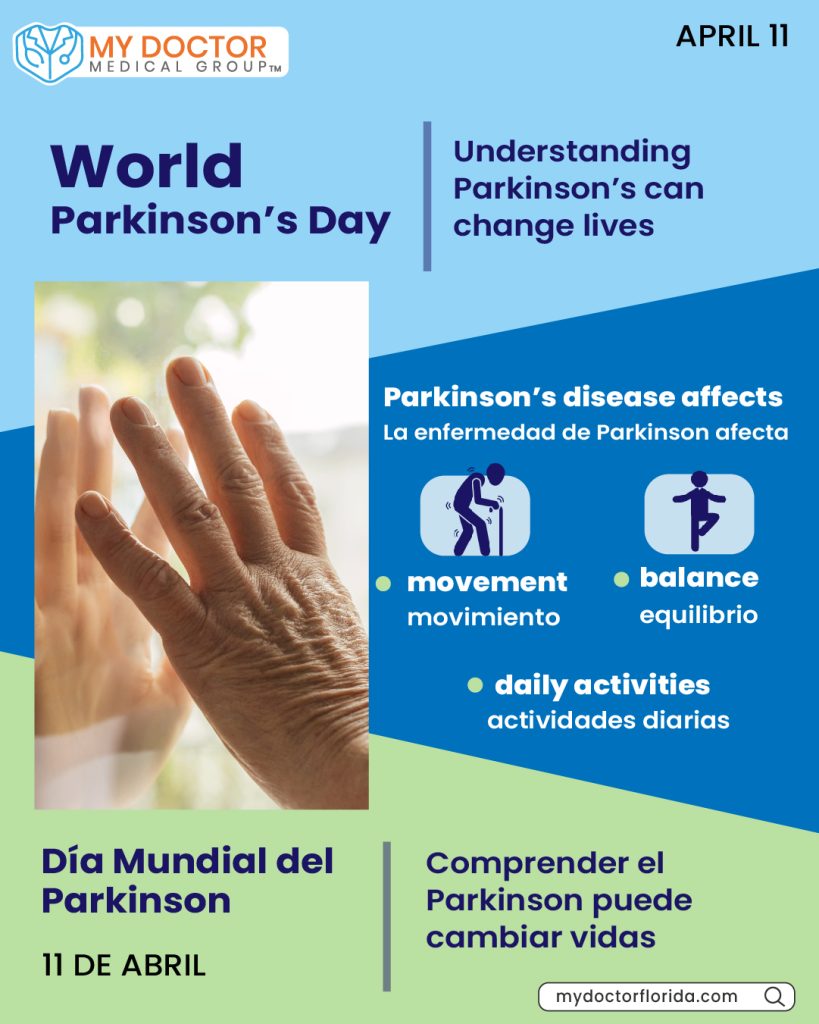
World Parkinson’s Day, celebrated every April 11 in honor of Dr. James Parkinson, who first described the disease in 1817, is an opportunity to raise awareness, reduce stigma, and encourage people to seek timely medical care.
How many people live with Parkinson’s worldwide?
According to the World Health Organization, more than 8.5 million people worldwide have a Parkinson’s diagnosis. In the United States, this number exceeds one million cases, with approximately 90,000 new patients diagnosed each year. In Florida, with its large senior population, the number of people affected is especially significant.
Early warning signs of Parkinson’s that seniors should not ignore
Many seniors and their family members overlook symptoms that could indicate the beginning of this disease. Recognizing them early can open the door to treatments that significantly improve quality of life.
Motor symptoms: when the body starts sending signals
Resting tremor
This is the most well-known symptom of Parkinson’s. It typically begins in one hand, a finger, or a foot when the limb is at rest. Unlike other types of tremor, this one tends to decrease with voluntary movement.
Muscle rigidity
Muscles feel stiff or tight, which can cause pain or limit range of motion. Many seniors initially describe this as an unusual sense of fatigue or tension in the arms, shoulders, or neck.
Slowness of movement (bradykinesia)
Everyday tasks that were once simple, like buttoning a shirt, walking, or getting up from a chair, begin to take more time and effort. This progressive slowness is one of the most distinctive features of Parkinson’s.
Balance and posture problems
A person may lean slightly forward when walking and have an increased risk of falls. This is not always a result of normal aging and deserves a medical evaluation.
Non-motor symptoms: the ones that often go unnoticed
Loss of smell
Many patients report noticing a decrease in their ability to smell years before diagnosis. This is one of the earliest symptoms of Parkinson’s, though it is rarely associated with the disease by most seniors.
Sleep disturbances
Moving or speaking during deep sleep, or having very restless sleep, can be relevant neurological signals. Parkinson’s can affect sleep quality long before motor symptoms appear.
Changes in handwriting and voice
Handwriting may become smaller (micrographia) and the voice lower or more monotone. These subtle changes deserve medical attention if they appear progressively.
Chronic constipation and other autonomic symptoms
The autonomic nervous system may also be affected, causing persistent constipation, urinary difficulties, low blood pressure when standing up, or excessive sweating.
Important: none of these symptoms alone confirms a Parkinson’s diagnosis. Only a neurologist or specialist can perform an adequate evaluation. If you or a family member presents several of these signs, it is essential to seek medical care.
Parkinson’s diagnosis and treatment: what seniors need to know
How is Parkinson’s diagnosed?
There is no specific blood test or lab result to confirm Parkinson’s. The diagnosis is clinical, meaning it is based on the patient’s history, symptoms, and a detailed neurological examination. In some cases, imaging studies such as a DaTscan may be used to support the diagnosis.
This is why having a trusted doctor who knows the patient’s history well is essential. In Tampa, Florida, well-organized primary care clinics play a key role in the early detection of neurological conditions.
Is there a cure for Parkinson’s?
Currently, there is no cure for Parkinson’s. However, there are effective treatments that help control symptoms and maintain a good quality of life for many years. Treatment may include medications such as levodopa, physical therapy, speech therapy, occupational therapy and, in selected cases, procedures such as deep brain stimulation.
The importance of a multidisciplinary medical team
Managing Parkinson’s requires collaboration among several healthcare professionals: neurologists, primary care physicians, physical therapists, speech therapists, and social workers. Having a coordinated team significantly improves outcomes for the patient and their family.
How to support a family member with Parkinson’s: tips for caregivers
Home adaptations for greater safety
Small changes at home can reduce the risk of falls: grab bars in the bathroom, non-slip surfaces, good lighting, and removing loose rugs or cables are simple and highly effective measures.
Communication and emotional support
A Parkinson’s diagnosis can generate fear, sadness, and frustration both in the patient and in the family. Maintaining open communication, seeking support groups, and consulting mental health professionals are important steps for everyone’s emotional wellbeing.
Maintaining physical and social activity
Regular exercise, such as walking, swimming, or practicing tai chi, has shown benefits for seniors with Parkinson’s. Maintaining participation in social activities is also essential to protect mental health and a sense of connection.
Resources available in Tampa, Florida
Tampa has a broad network of resources for seniors with Parkinson’s and their caregivers, including support groups, specialized exercise programs, and home care services. Your primary care physician can help you connect with these resources.
At our clinic in Tampa, Florida, we have professionals committed to the health of seniors and their families.
Research and hope: advances in Parkinson’s disease
Science advances every year in understanding Parkinson’s. Researchers worldwide are studying new genetic therapies, neuroprotective treatments, and monitoring technologies that could change the outlook for this disease in the coming years. Organizations such as the Parkinson’s Foundation and the Michael J. Fox Foundation for Parkinson’s Research fund important studies that offer hope to millions of people.
The role of genetics and lifestyle
While most cases of Parkinson’s are not of genetic origin, certain lifestyle factors, such as regular exercise, a balanced diet, and stress management, are being studied for their possible role in reducing risk. Quality sleep and cognitive stimulation also appear to be protective of neurological health in seniors.
 English
 Spanish